
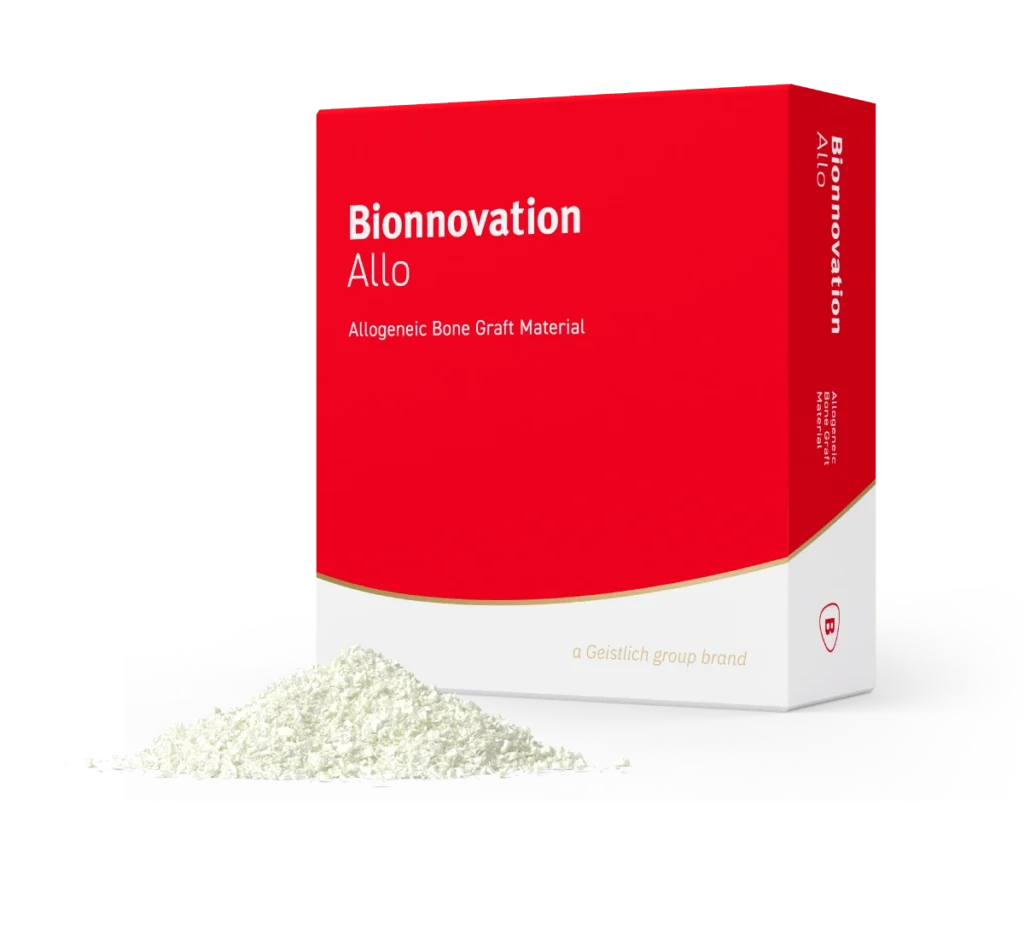
Bionnovation
Allo
Allogeneic Bone Graft
The allograft that
changes things
Experience confidence for repairing, replacing or reconstructing bone in daily dental procedures with Bionnovation Allografti. Designed to support predictable handling, each graft is processed using the validated Cancelle SP® Sterilization Process to ensure a sterility assurance level (SAL) of 10-6.1

Donor Quality. Comprehensive Screening.
Each graft is processed from carefully screened and tested donor tissue, including, but not limited to, medical record review, risk assessment interviews, and physical evaluation.

Validated Process. Trusted Safety.
Processed using the proprietary Cancelle SP® Sterilization Processii, a validated method designed to sterilize DBM and cortical cancellous chips and to inactivate and/or remove a panel of microorganisms, without the use of antibiotics.2

Verified Testing. Biological Potential.
Each lot of implants containing DBM is tested for BMP-2.² BMPs are recognized as a marker associated with osteoinductive potential.2,3,iii,iv

When to use it
Bionnovation Allo is ideal for your everyday dental bone augmentation procedures.
- Ridge augmentation and preservation
- Implant placement
- Extraction socket
- Sinus floor elevation

LEARN
Education That Fits Your Practice
Browse a curated collection of clinician-submitted cases showcasing real-world applications and treatment outcomes. Each case offers practical insights to support your clinical decision-making.


SHOP
Visit the Eshop
With a streamlined portfolio of biomaterials and services, it makes quality biomaterials accessible to patients around the world.
Resources

FAQs
Q: When do I use a xenograft versus allograft? When do I use both?
A: Xenografts and allografts are both widely used in bone regeneration, but they serve different clinical purposes depending on the treatment goal:
- Allografts are preferred when faster integration and replacement by the patient’s own bone are desired, making them well suited for routine socket preservation and contained defects.
- Xenografts are chosen when long-term volume stability is critical, as they remodel more slowly and help maintain the shape of the ridge over time, for example in sinus augmentation or aesthetic cases.
In practice, the decision comes down to balancing healing speed versus structural stability, with clinicians selecting the material based on defect type and the desired regenerative outcome.
Q: Why use an allograft?
A: Allografts are widely used because they provide a reliable scaffold for new bone growth, supporting the body’s natural regeneration process. They help maintain volume and space in procedures such as ridge preservation or guided bone regeneration. A key advantage is that they eliminate the need for a second surgical site, which reduces patient morbidity and simplifies treatment. In addition, allografts are available in various formats and are easy to handle, making them a versatile and convenient solution for daily clinical practice.
Q: How are allografts regulated?
A: Allografts are subject to strict regulatory oversight to ensure quality, safety, and traceability. In the United States, the Food and Drug Administration (FDA)’s 21 CFR 1271 regulations apply to all U.S. tissue banks and their affiliates. In addition, organizations such as the American Association of Tissue Banks (AATB) set stringent guidelines for donor selection, processing, and distribution. Regulations cover every step of the process, from donor eligibility and testing to storage, labeling, and traceability, ensuring full control from donation to clinical use.
Q: Where do allografts come from?
A: Allografts originate from human donors, most commonly from deceased individuals who have consented to tissue donation. The material is recovered through licensed tissue banks and then processed into clinically usable formats such as particles or blocks. In some cases, tissue may also come from living donors, for example during orthopedic procedures, although this is less common.
Q: How are allograft donors screened and tested?
A: Before any tissue is accepted, donors undergo a rigorous screening and testing process. This includes a detailed review of medical and social history as well as a risk assessment to identify potential exposure to infectious diseases. Laboratory testing is mandatory and typically includes screening for HIV, hepatitis B and C, and other pathogens. After retrieval, the tissue undergoes advanced processing and sterilization procedures designed to remove cells and eliminate contaminants while preserving the structural properties needed for regeneration.
Q: Are allografts safe?
A: Allografts have a strong safety record when sourced from accredited tissue banks and used according to established guidelines. The combination of strict donor screening, comprehensive testing, and advanced processing significantly reduces the risk of disease transmission. Clinical evidence confirms that allografts are safe and effective for dental applications, with the risk of infection transmission reported to be extremely low. Continuous regulatory oversight and traceability systems further reinforce their safety profile and reliability in everyday clinical use.
Q: How do tissue banks differ?
A: Tissue banks are required to register with the U.S. Food and Drug Administration (FDA) and are inspected regularly for compliance to federal regulations. The American Association of Tissue Banks (AATB) is a voluntary industry led organization that provides additional recommendations on standards that affect allograft safety and efficacy. Beyond the FDA and the AATB recommendations, each tissue bank has its own methods for donor screening, processing and sterilization which play a role in the safety of the grafts provided for clinical use. It is important to ask questions regarding a tissue bank’s donor screening criteria, processing methods, testing, and studies to ensure the allografts used meet the clinical need for safety and efficacy. It is important to note that RTI Surgical, Inc. d/b/a Evergen is accredited by the AATB and ISO 13485:2016 certified.
Q: Are allografts visible on radiographs?
A: Mineralized allografts are visible on radiographs due to the mineral content in the materials. Demineralized bone, however, is not visible on radiographs, until the bone is reincorporated as a part of the healing process and becomes mineralized.
Q: Are cancellous and cortical bone both osteoconductive?
A: Yes, both mineralized and demineralized cancellous and cortical bone can provide osteoconduction. Osteoconduction by definition means that bone grows on a surface. An osteoconductive surface is a matrix that permits bone growth on its surface or within its pore structure.1 Given that cortical and cancellous bone can serve as a scaffold for ingrowth of new bone, they both can be considered osteoconductive.2
Q: What is the resorption profile of a demineralized versus a mineralized allograft?
A: Demineralized bone will have a faster absorption profile compared to mineralized grafts. Mineralized bone grafts will integrate between 6-12 months depending on particle size, whereas demineralized bone grafts will integrate within 18-20 weeks.3 Traditionally a blend of mineralized and demineralized grafts is used to balance the healing process and incorporation times.
Q: What are the advantages of demineralized bone versus mineralized bone? Where would you use a demineralized allograft versus a mineralized allograft in clinical procedures?
A: The demineralized bone has been treated to remove the calcium and expose the inherent growth factors in bone. Mineralized allograft remains longer, providing a matrix for new bone formation to occur. The main clinical use for demineralized allograft is guided tissue regeneration.4
References:
- Albrektsson T, Johansson C. Osteoinduction, osteoconduction and osseointegration. Eur Spine J. 2001;10(Suppl 2):S96–S101. doi:10.1007/s005860100282
- Roberts TT, Rosenbaum AJ. Bone grafts, bone substitutes and orthobiologics. Organogenesis. 2012;8(4):114–124. doi:10.4161/org.23306.
- Wood and Mealey, Histologic comparison of healing after tooth extraction with ridge preservation using mineralized versus demineralized freeze-dried bone allograft, J Periodontol, March 2012.
- Gruskin, E. et al. Demineralized bone matrix in bone repair: History and use. Advanced Drug Delivery Reviews 64 (2012) 1063-1077.
References:
- Data on file with Evergen
- Asahina, I. Bone Morphogenetic Proteins: Their History and Characteristics. Journal of Hard Tissue Biology, 23(3), 283-286, 2014
Disclaimers:
- The implant is processed by RTI Surgical, Inc.
- Cancelle SP® is a registered trademark of RTI Surgical, Inc. d/b/a Evergen.
- Lab data may not be representative of effects or performance in humans.
- Performance data from animal models may not be representative of performance in humans.